

Cleaning castings and forgings: sand, scale and core removal
Castings leave the mould carrying burnt-on sand and scale, and forgings carry oxide from the furnace. Wheel blasting clears both quickly and shows the surface for inspection and machining.
What the foundry needs from blasting
A clean, uniform surface that shows cracks, cold shuts and porosity at inspection, takes machining without sand dulling the tools, and holds paint or coating. Blasting also blends minor surface marks, which matters on castings that are sold as-cast.
Hanging, laying or tumbling
Parts that can hang are cleaned on a spinner hanger: the hook rotates the load in front of the wheels so every face is reached, and a Y-track lets one hook be loaded while the other blasts. Heavy or flat pieces that cannot hang sit on a rotating table. Small robust parts in volume are usually tumbled. The choice follows the weight and fragility of the part, and how it is handled before and after.
Internal passages and cores
Wheels clean what they can see. Water jackets, ports and deep pockets are finished with an air blast lance or nozzle that follows the passage, either by hand in a cabinet or under program control in an automated cell.
Media and separation
Foundry work loads the abrasive with sand, which is abrasive to the machine itself. An efficient air-wash separator that pulls sand and fines out of the operating mix is what protects blades, liners and wheel housings, so it deserves as much attention as the wheels when a machine is specified.
At a glance
| Typical parts | Grey and ductile iron castings, steel castings, aluminium castings, closed-die forgings |
|---|---|
| What is removed | Moulding sand, core sand, scale, oxide and heat-treat discolouration |
| Media | Steel shot for iron and steel; stainless shot, aluminium cut wire or zinc shot for aluminium |
| Machine | Spinner hanger for castings that hang; table blast for heavy or awkward single pieces; air blast for cores and internal passages |
Finish grades, profiles and media on this page describe common industry practice. Your coating or process specification governs.
Machines for this job
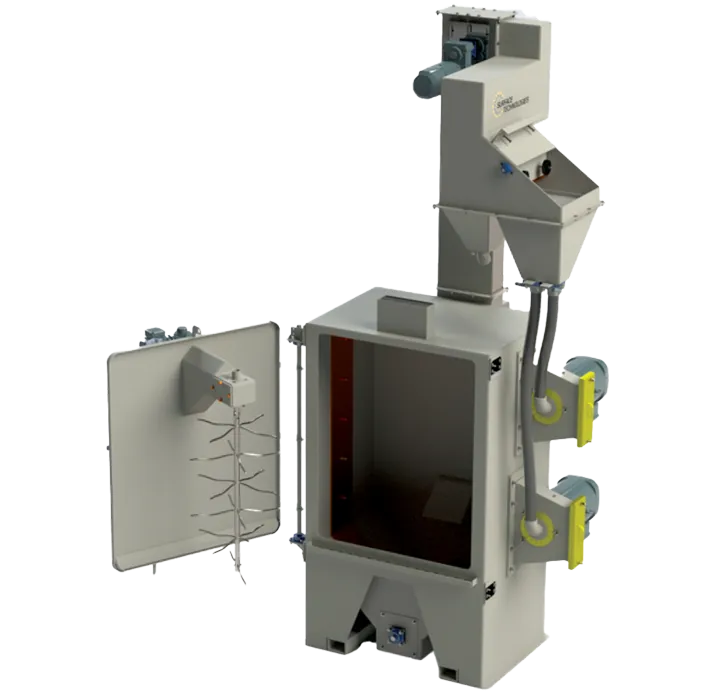
Spinner Hanger & Carousel Shot Blast Machine
Parts hang on rotating hooks while centrifugal wheels clean every face.
See the machine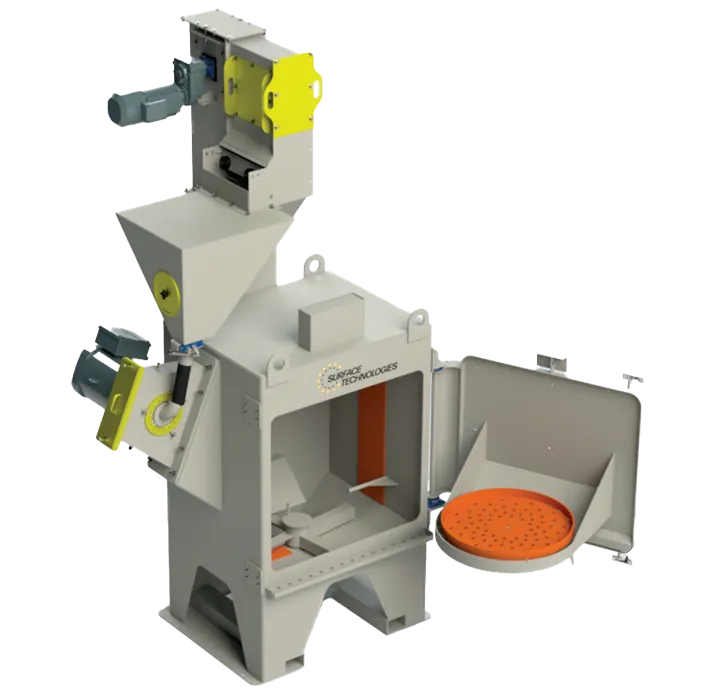
Table Blast Machine
A rotating worktable exposes every surface of heavy parts that can't be tumbled or hung.
See the machine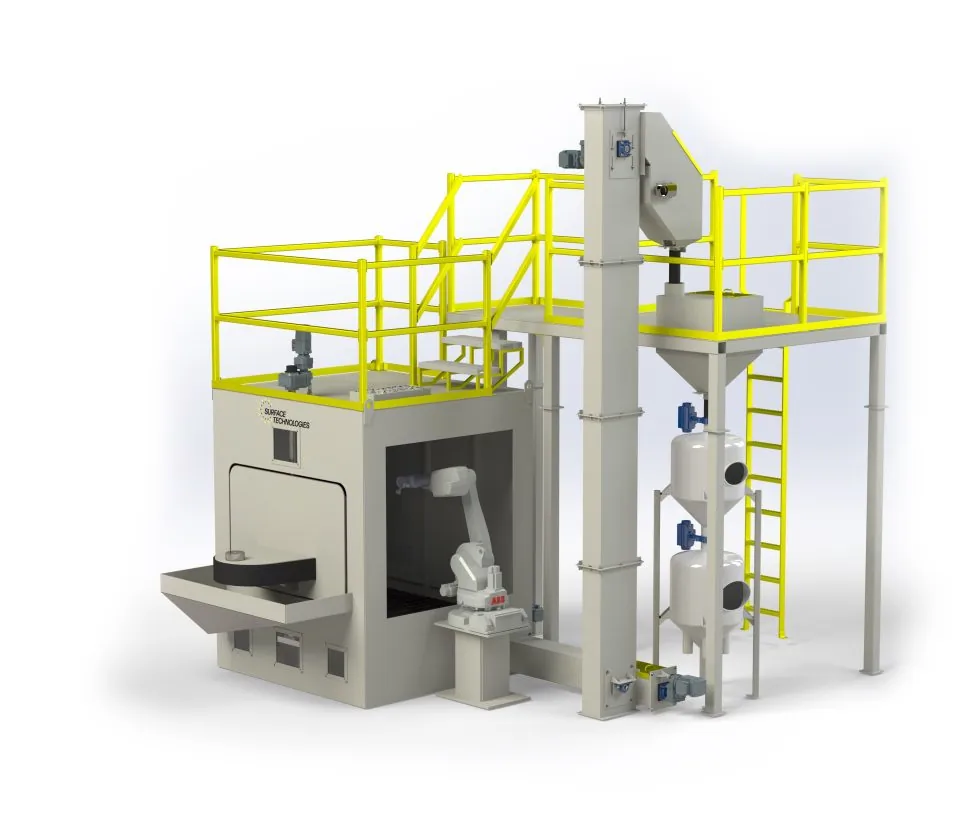
Air Blasting Equipment & Machines
Compressed-air blasting from a small manual cabinet to a fully automated cell with part manipulation.
See the machineCommon questions
Can aluminium castings be shot blasted?
Yes, with the right media and wheel speed. Stainless shot, aluminium cut wire or zinc shot clean without embedding iron, and dust collection must be designed for aluminium fines.
How long does a casting cycle take?
It depends on the alloy, how much sand is on the part and the finish needed. A trial on your own castings is the reliable way to set a cycle time.
Does blasting affect dimensions?
Cleaning cycles remove contamination rather than base metal, so machined allowances are not affected in normal use. Thin fins and sharp edges will be rounded slightly.
Related
Automotive Production
Centrifugal shot blast systems that keep a production line moving: coating prep, peening, deburring and scale…
IndustryJob Shop Production
Faster turnaround on high-mix, low-volume work: one-step cleaning, deburring and prep that holds dimensional…
ApplicationDescaling plate and structural steel
Hot-rolled steel arrives with a layer of mill scale that paint will not hold to and welds do not like.
ApplicationRust and paint removal
Refurbished equipment, returned racks and corroded stock all need to come back to bare, profiled metal before they can…