

Removing heat-treat and forging scale
Furnaces leave a tight oxide scale on steel that dulls cutting tools, hides defects and stops coatings from bonding. A wheel blast cycle clears it in minutes.
Why scale matters after heat treatment
Scale is harder than the tooling that will machine the part, so leaving it on shortens tool life sharply. It also masks quench cracks from inspection and prevents plating, paint and phosphate from bonding.
Blasting hardened parts
Hardened steel is cleaned with shot rather than aggressive grit, at an intensity that removes the oxide without altering the surface more than the drawing allows. Where the part is also to be peened, cleaning and peening are treated as separate, controlled operations.
Forgings
Forging scale is thicker and more tenacious than heat-treat scale. A coarser shot or a shot and grit mix breaks it, and a spinner hanger or table machine presents the deep recesses of a forging to more than one wheel.
Order of operations
Wash off quench oil first, since oil carries into the abrasive and onto every following part. Blast, then inspect, machine or coat. Parts that will sit before the next step may need a rust preventive, because freshly blasted steel is chemically active.
At a glance
| Typical parts | Quenched and tempered components, forgings, gears, shafts, fasteners, tool steel |
|---|---|
| What is removed | Furnace scale, quench-oil residue after washing, temper colour |
| Media | Steel shot; a shot and grit mix on heavy forging scale; non-ferrous or ceramic media on stainless and titanium |
| Machine | Spinner hanger or table blast for batches; air blast for precision and thin sections |
Finish grades, profiles and media on this page describe common industry practice. Your coating or process specification governs.
Machines for this job
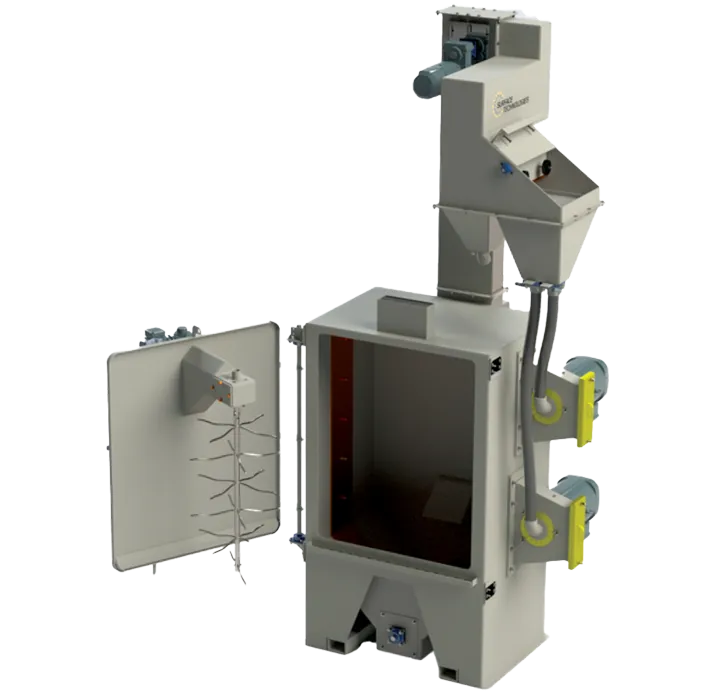
Spinner Hanger & Carousel Shot Blast Machine
Parts hang on rotating hooks while centrifugal wheels clean every face.
See the machine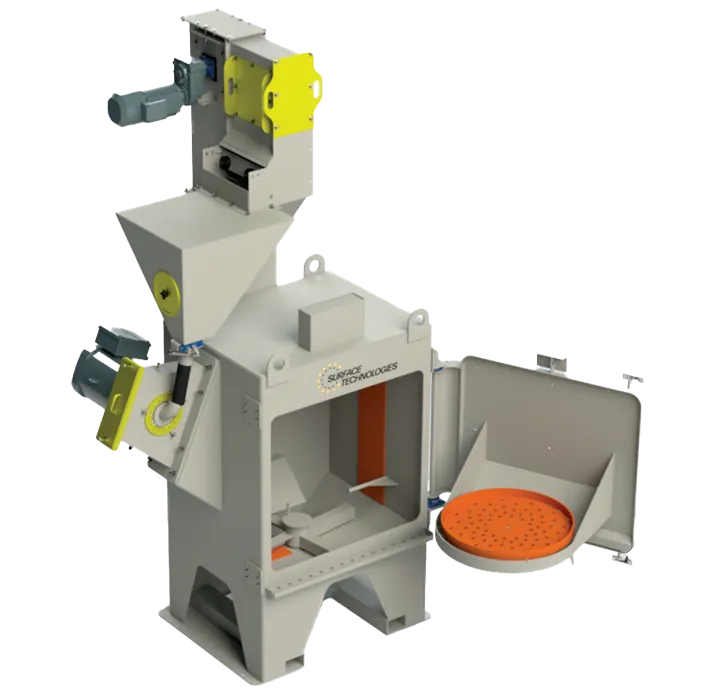
Table Blast Machine
A rotating worktable exposes every surface of heavy parts that can't be tumbled or hung.
See the machine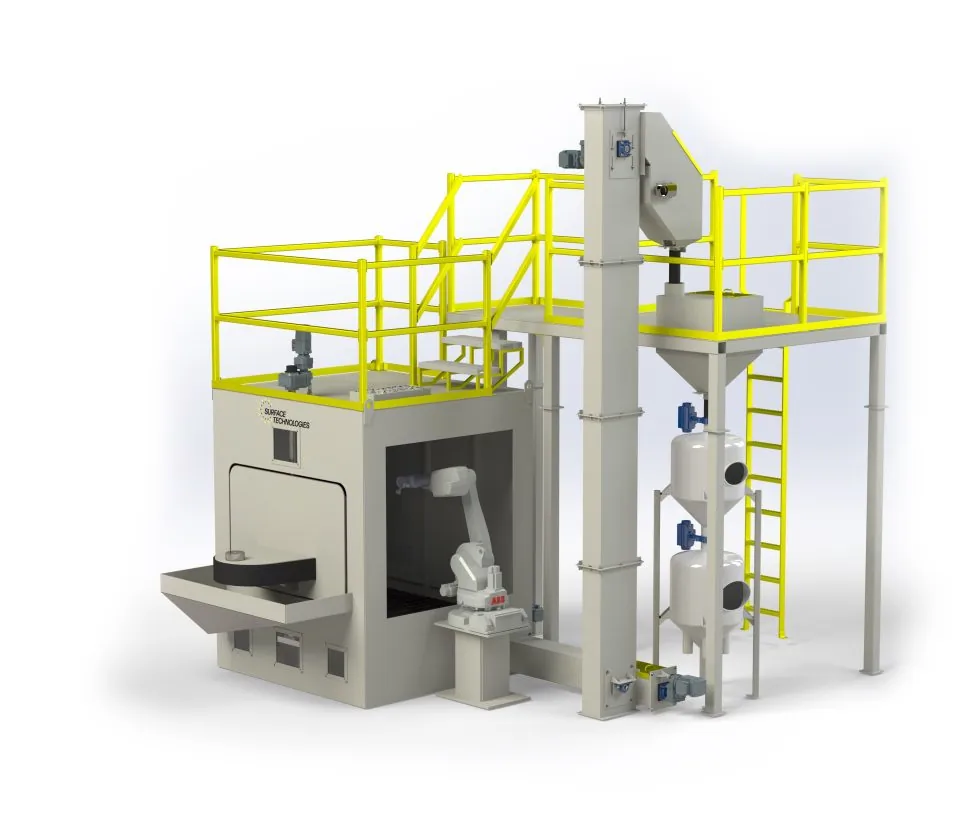
Air Blasting Equipment & Machines
Compressed-air blasting from a small manual cabinet to a fully automated cell with part manipulation.
See the machineCommon questions
Does shot blasting change hardness?
A cleaning cycle does not change through-hardness. It does lightly cold-work the surface, which is generally beneficial.
Can small heat-treated parts be tumbled?
Robust small parts can be tumble blasted in batches. Parts with fine threads or thin sections are better racked or blasted on a table.
Is blasting better than pickling?
Blasting avoids acid, the risk of hydrogen embrittlement on high-strength steel and the waste stream that pickling creates.
Related
Automotive Production
Centrifugal shot blast systems that keep a production line moving: coating prep, peening, deburring and scale…
IndustryJob Shop Production
Faster turnaround on high-mix, low-volume work: one-step cleaning, deburring and prep that holds dimensional…
ApplicationDescaling plate and structural steel
Hot-rolled steel arrives with a layer of mill scale that paint will not hold to and welds do not like.
ApplicationRust and paint removal
Refurbished equipment, returned racks and corroded stock all need to come back to bare, profiled metal before they can…