

Special Machines & Shot Peening
When the part, the line or the specification doesn't fit a standard machine, we engineer one around it: walking beams, pushers and in-line machines for single parts, and shot peening machines that hold intensity and coverage to the specification. Covers shot peening machines, walking beam blast machines, pusher machines and in-line blast systems.
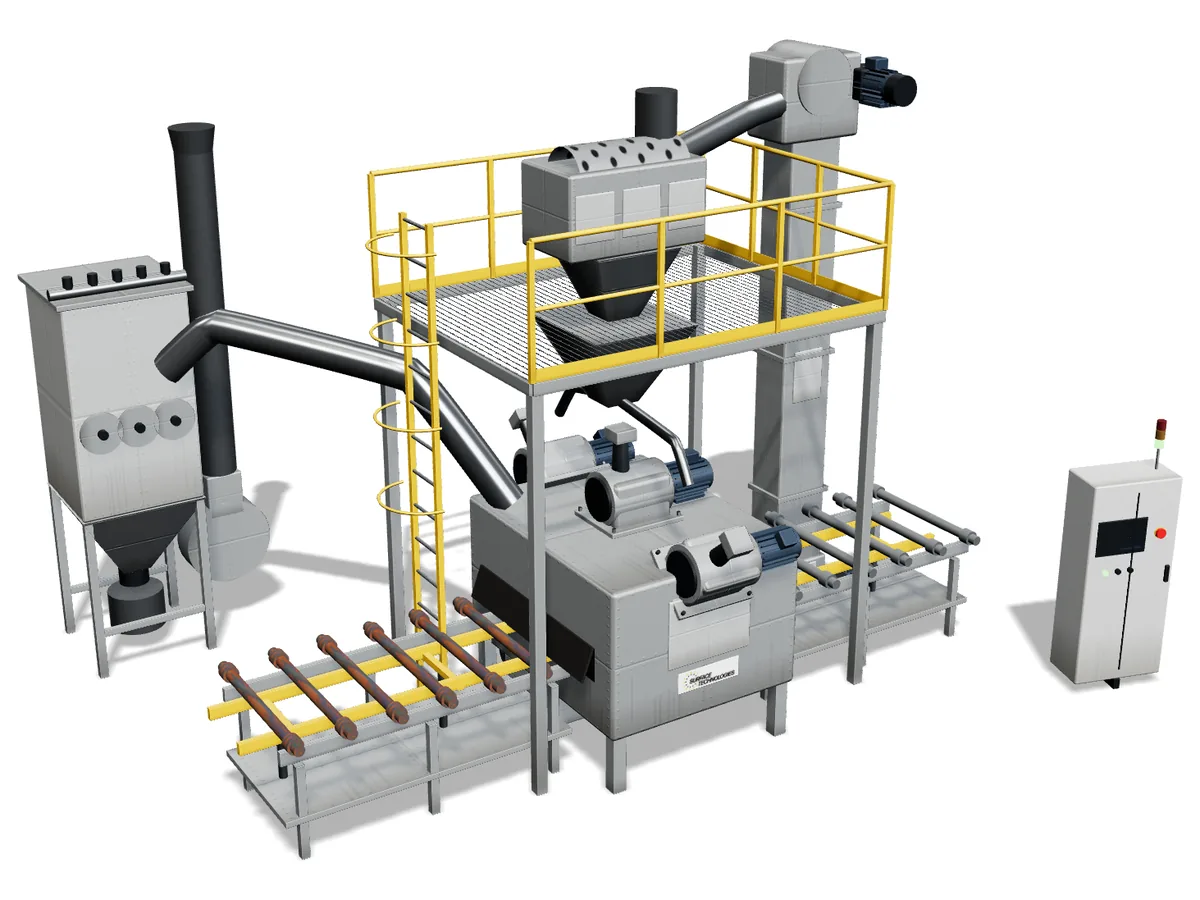
What's in the machine
- Part handling designed for the part: walking beam, pusher, roll conveyor or fixture
- Wheel count and position taken from the part geometry
- For peening: controlled shot size, wheel speed and shot flow, so intensity and coverage repeat
- In-line with forming, heat treatment or coating
- Controls and HMI built for the process
Options
- Variable wheel speed and shot flow control
- Almen strip fixtures for intensity checks
- Automated loading and unloading
- Shot classification to hold the size in spec
Specifications engineered to the part
| Sizing | Work opening, wheel count and horsepower are set from your part portfolio and throughput. |
|---|---|
| Power | 460 V 3-phase, 24 VDC controls; panel certified to the installation jurisdiction. |
| Dust collection | Sized to the cabinet and seals; see utility requirements. |
| Lead time | See current lead times. |
How it runs
- The part is located by the handling system
- It moves or turns through the blast on a set pattern
- Wheels deliver the shot at a controlled speed and flow
- For peening, intensity is checked with Almen strips
- The part moves on to the next operation
Example configurations
Layouts we have proposed for different parts and volumes. Every machine is engineered to the part, so yours will be sized to your work.
- Walking beam blast machine, 2 wheels at 20 HP
- Pusher machine for cleaning tanks, 2 wheels at 25 HP
- In-line walking beam peening for leaf springs
- Rail wheel peening machine
- Cathode blaster on a roll conveyor
See it run in 3D
A working model of the special & peening machine in a plant setting. Watch the cycle, open it up, follow the part, trace the media loop and check the dimensions. Drag to look around; tap the machine to switch between the outside and the inside.
- Parts are loaded onto the walking beam
- The beam lifts and indexes each part one pitch
- Three wheels in a fan peen the turning part
- Parts index out through the swinging seals
- Unload and check intensity with Almen strips
Shown: a walking beam machine after one of our proposal layouts. Special machines are engineered around your part. Illustrative model for visual purposes only: every machine is engineered to order, so sizes, spacing and layout follow your part.
Industries that run it
- Leaf springs and suspension parts
- Rail wheels
- Billets and mill products
- Cylinders and tanks
- Carbon for aluminium smelting
- Springs, gears and shafts
Applications
Plan the install
- Utility requirements for power, air and ventilation
- Pre-installation checklist
- Lead times and the delivery guide
- Budget the full line with the estimator
- Ways to buy
Related reading
How shot blasting works
Wheels, media, separators and dust: the whole loop explained in plain terms.
GuideChoosing a shot blast machine
Match the machine type to your part, volume and finish spec before you ask for a price.
GuideSite requirements for blast equipment
Power, compressed air, ventilation, floor, ceiling height and access: what to have ready before delivery.
GuideDelivery and lead times
What happens between the PO and the first part off the line, and how long each step takes.
Questions we get asked
What is the difference between shot blasting and sand blasting?
Shot blasting is the industry term for treating steel with propelled media, mostly in automated equipment: to descale, and to prep for paint. Sand blasting is, in essence, shot blasting done in a manual environment. Nobody really uses sand; the media is aluminum oxide, garnet, walnut or other compounds.
What is shot peening?
A controlled form of shot blasting. Electrical controls set the size and depth of the dent in the steel, which reduces residual stress in the part. It is used wherever parts need less fatigue and a longer life.
Do you stock replacement parts?
We have stocking programs for specific needs. We encourage keeping critical parts next to the machine, but if you're short on space we're happy to stock important parts for your process.
Do you guarantee the performance of your parts?
Yes. We support new and existing equipment in the field, identify problems before they become serious, and offer programs that guarantee machine performance.