

Rust, paint and coating removal by abrasive blasting
Refurbished equipment, returned racks and corroded stock all need to come back to bare, profiled metal before they can be recoated. The right machine depends on how big the part is and how many you have.
What has to come off
Rust, mill scale under old paint, the paint itself and anything trapped beneath it. A coating applied over rust or a failing paint film inherits the failure. Blasting takes the surface back to clean metal and leaves a uniform profile in the same step, which sanding, wire wheels and chemical strippers do not.
Large or one-off parts: a blast booth
A walk-in booth lets an operator work a part of any shape with a pressure nozzle. A recovery floor returns the abrasive to the pot, and cross-draft or down-draft ventilation keeps the operator able to see the work. It is the flexible choice for equipment rebuilders, fabricators and maintenance shops whose parts change every day.
Repeating parts: wheel blast
When the same racks, castings or frames come back every week, a spinner hanger or table machine cleans them faster and at a lower cost per part than a nozzle can. The wheels do the work while the operator loads the next batch.
Thin or soft substrates
Aluminium, thin sheet and precision parts warp or lose dimension under aggressive steel abrasive. An air blast cabinet with glass bead, fine aluminium oxide or plastic media strips the coating at lower energy and leaves the base metal intact.
At a glance
| Typical parts | Heavy equipment frames, trailers, tanks, racks and fixtures, returned castings, restoration work |
|---|---|
| Finish specified | Sa 2½ / SP 10 before high-performance coatings; Sa 2 / SP 6 for general repainting |
| Media | Steel grit for speed on steel; aluminium oxide or garnet in a booth; glass bead or plastic media where the base metal must not be cut |
| Machine | Blast booth for large or one-off work; spinner hanger or table machine for repeating parts |
Finish grades, profiles and media on this page describe common industry practice. Your coating or process specification governs.
Machines for this job
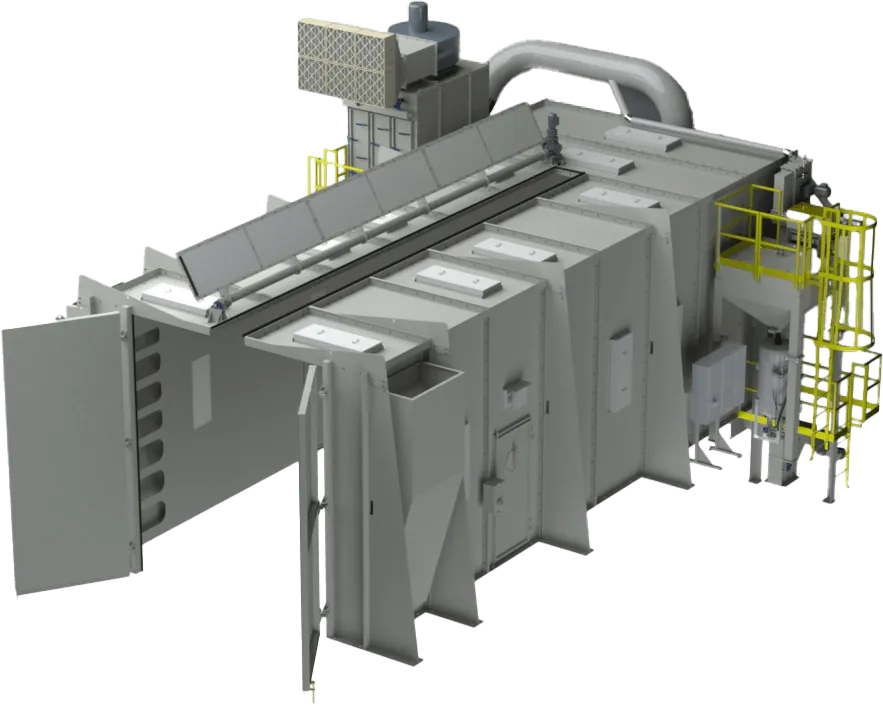
Blast Booth (Sandblasting Booth)
A controlled enclosure for surface preparation of large or intricate components.
See the machine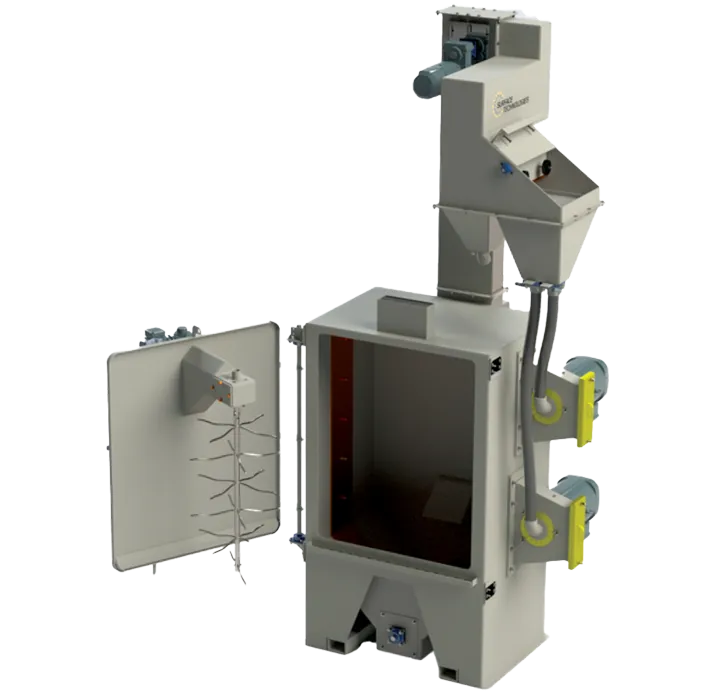
Spinner Hanger & Carousel Shot Blast Machine
Parts hang on rotating hooks while centrifugal wheels clean every face.
See the machine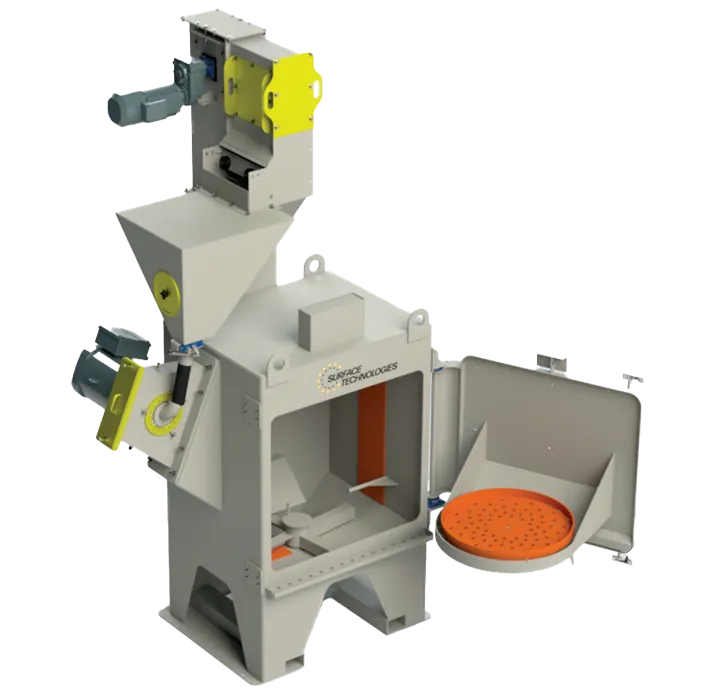
Table Blast Machine
A rotating worktable exposes every surface of heavy parts that can't be tumbled or hung.
See the machine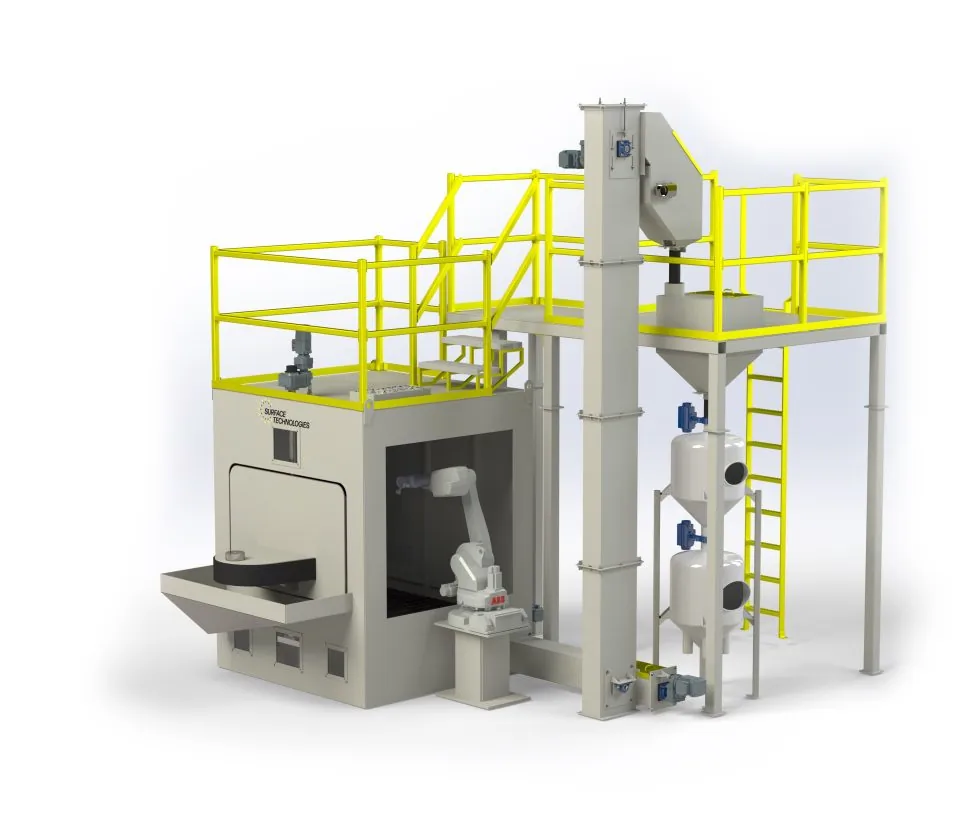
Air Blasting Equipment & Machines
Compressed-air blasting from a small manual cabinet to a fully automated cell with part manipulation.
See the machineCommon questions
Will blasting remove heavy rust pitting?
It removes the corrosion product from the pits and shows how much sound metal remains. It does not restore lost thickness, so inspect pitted sections after blasting.
How soon should blasted steel be coated?
As soon as practical, and before visible flash rust forms. In a dry shop that is usually the same shift; in humid conditions the window is shorter. The coating data sheet gives the limit.
Is sandblasting the same thing?
Sandblasting is the older name for air blasting. Silica sand is no longer used because of the health risk; modern booths run steel grit, garnet, aluminium oxide and other engineered abrasives.
Related
Construction
Stronger structures start with surface treatment.
IndustryJob Shop Production
Faster turnaround on high-mix, low-volume work: one-step cleaning, deburring and prep that holds dimensional…
ApplicationDescaling plate and structural steel
Hot-rolled steel arrives with a layer of mill scale that paint will not hold to and welds do not like.
ApplicationSurface preparation for coating
Most coating failures start at the surface, not in the coating.